
Do you want your article to be featured on our website? Please include your email and your article suggestion(s) and we will get in touch with you! Keep in mind that our articles are catered towards candidates (living or interested in moving to the Netherlands) or companies in the Netherlands. Therefore, we can only consider relevant suggestions.
Dutch Job Market: Facts and Guidance for Your Job Search

Two key factors profoundly influence the success of your job search: the JOB MARKET and YOURSELF.
Successfully navigating the Dutch job market requires a clear understanding of the current landscape. Before taking any action, it's essential to assess your situation, as this will shape both your decision-making and expectations.
I encourage you to take an active role in your job search. Seek out opportunities and track your efforts diligently. This hands-on experience will give you critical insights into the market and highlight the gap between your ambitions and reality. Remember, job searching demands the same dedication as a full-time position.
By immersing yourself in this process, you will gain clarity about your needs for assistance and the specific support required. This self-awareness fosters a foundation of trust, enabling the collaboration to be both meaningful and effective when you request professional support. With insights from your experiences, actions can be taken promptly to analyze your background, define your market position, reshape your professional profile, implement impactful adjustments, and strategize a tailored path toward securing a successful job offer.
Part one: The JOB MARKET
The current landscape -- The Dutch Job market
Understanding the current Dutch job market is fundamental for making informed decisions and setting realistic expectations during your job search. This realistic outlook can sustain your efforts and help you overcome challenges.
Together, I invite you to explore the story of the Dutch job market, showcasing its various dimensions and key indicators that are essential for job seekers.
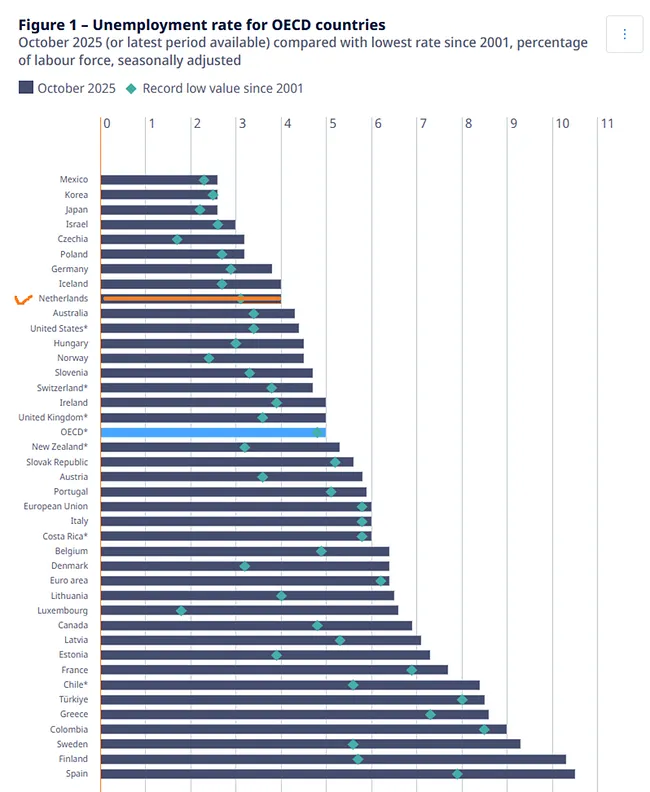
How is the Dutch job market doing compared to other countries globally in terms of the unemployment rate?
- The Dutch job market continues to demonstrate resilience within the OECD (The Organisation for Economic Co-operation and Development) countries.
As of October 2025, the unemployment rate stood at a strong 4%, which is 1% lower than the OECD average and favourable compared to most other OECD nations.
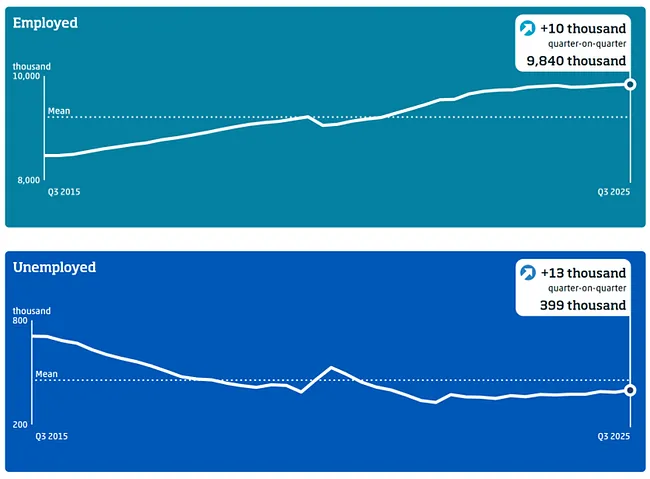
What is the employment and unemployment situation in the Netherlands?
- Both the employment and unemployment rates experienced a slight increase in the QoQ comparison from Q2 to Q3 in 2025.
- This suggests that while companies are continuously filling vacancies, layoffs are still occurring.
- Notably, the unemployment rate showed a significant decrease within Q3 2025, indicating an improvement in job retention and opportunities.
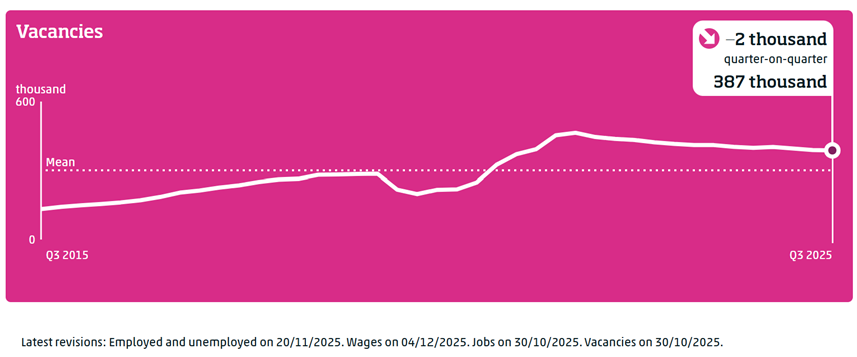
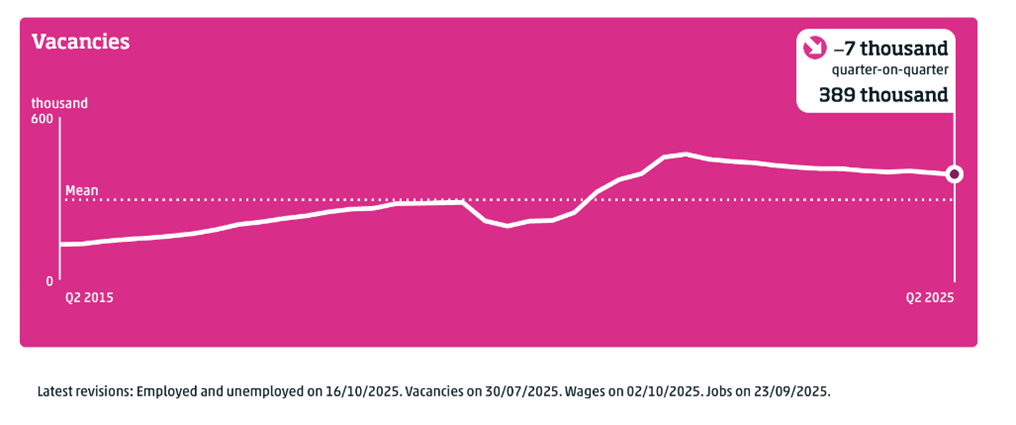
Is the number of vacancies in the Dutch job market increasing or decreasing?
- During both Q2 and Q3 of 2025, the number of vacancies showed an upward trend within each quarter.
- However, a QoQ comparison reveals a slight decrease of 9,000 vacancies from Q1 to Q3, indicating a modest tightening in the availability of new roles.
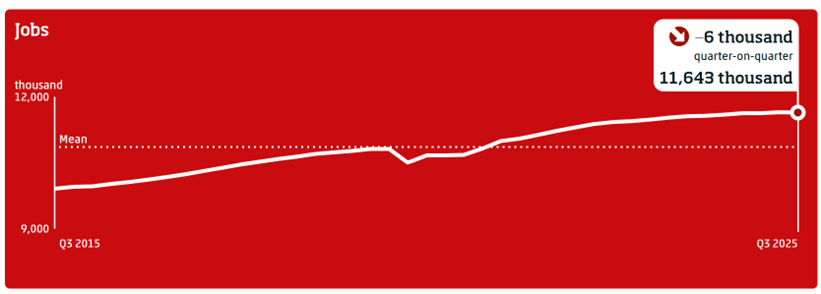
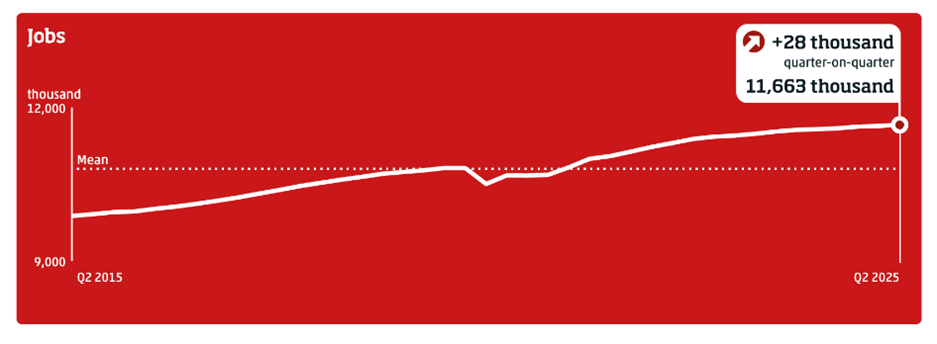
How is the total amount of people occupying job positions?
- A QoQ comparison shows a slight increase, with 22,000 more new jobs being filled from Q1 to Q3 2025.
- This stability reflects a generally positive situation in the Dutch job market at an overall level.
How is the competition among the candidates in the Dutch job market?
- TENSE! The Dutch job market remains competitive.
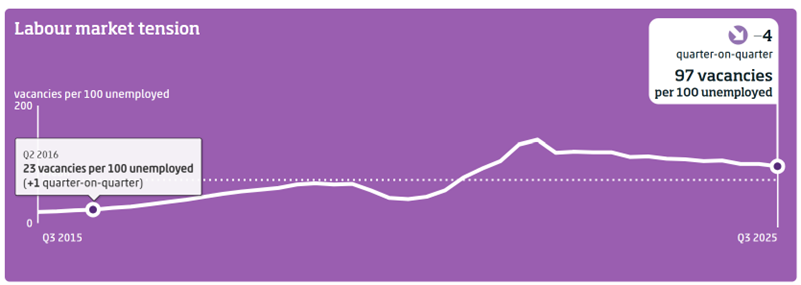
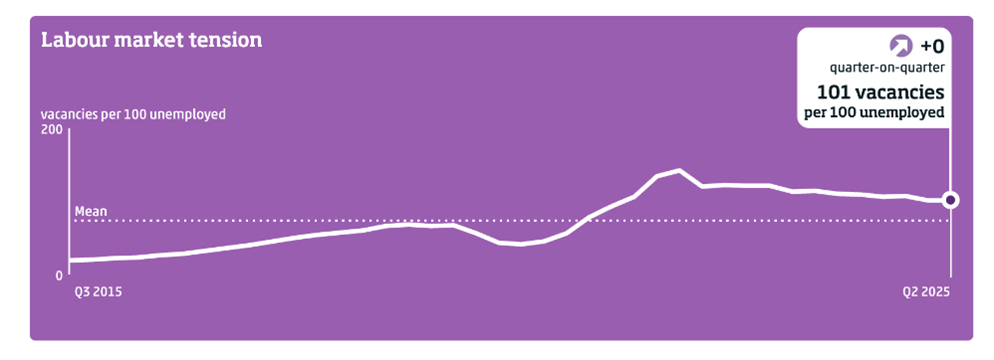
While job matching is always a factor, the number of available vacancies per 100 unemployed persons provides an indication of market tension.
In Q2 2025, there were 101 vacancies for every 100 unemployed individuals, indicating a near-balance.
However, this eased slightly to 97 vacancies per 100 unemployed in Q3 2025, suggesting a moderately tighter market for job seekers in the most recent quarter.
In essence, while the Dutch job market remains robust and stable overall, job seekers should anticipate a moderately competitive environment with a slight cooling in new vacancy growth during the latest quarter. A realistic and proactive approach remains key for successful job searching.
Part two: YOURSELF
ACT on your PREPARATION!
Think slow, act fast. In job searching, it's all about preparing thoroughly and acting decisively!
While continuous effort is vital, it’s imperative to truly understand how your previous professional background is perceived in the Dutch job market.
Successfully making this transition during your preparation will significantly enhance your chances of advancing to the next stage of your job application. The transition results will be reflected in various ways, including your CV, motivation letter, verbal communication during phone calls, and your body language and responses during interviews—all of which Dutch recruiters will assess.
There are many elements we can and should tackle for the job application preparation:
- How do Dutch recruiters read your CV?
- Why is motivation letter important?
- What are the cultural differences of interviews?
- Mass application or customized application?
- Should I consider training courses?
- What else can I do?
- ...
In this article, we will focus on the essential transition that needs to happen within yourself, forming the foundation for your subsequent actions in the application process.
What transition and why transition?
Do the following expressions or perspectives from job seekers sound familiar to you?
- “I have a university education background...”
- “I have professional work experience in the country where I am from...”
- “I have skills developed from my previous jobs in my country...”
- “I am looking for a job as a ...”
- “I want to work in ‘xx’ industry...”
- “I am (not) good at...”
Now, let’s consider the perspective of recruiters or employers in the Dutch job market:
- “With more than 200 applications received, I will spend only 10 seconds on my first resume screening...”
- “This profile looks interesting, I will spend 1 – 2 minutes to look at the details...”
- “This profile looks strong, but it doesn’t resonate with me...”
- “It’s completely irrelevant...”
- “It costs energy to understand this profile...”
- “The interview conversation went well, but he/she isn’t the right fit...”
- “Everything seems okay, but I can’t quite get a feel for them...”
è The core issue is often that the message from job seekers is not received accurately or effectively by the recruiter or interviewer, leading to missed opportunities.
We cannot change how recruiters or companies assess and select candidates, but we can adjust our mindset and behaviour to win and secure opportunities. This is precisely where the transition needs to happen. It is the bridge you need to build to connect your past profile and diverse geographical experiences with the current requirements of the Dutch job market, transforming it into a format that is recognized and accepted by Dutch recruiters and companies.
Hands-on guidance to enable the transition:
This is the most critical and often challenging step in the job application process. It involves collecting both external and internal inputs that need to be decoded, analyzed, sorted, regrouped, and linked. It requires the ability to learn, recognize, accept, and integrate something newly built until it becomes an authentic part of you. Once this transition occurs, the rest of the process becomes more operational.
Here are concrete steps to facilitate this transition:
- Thoroughly detail your professional profile and experience.
- Familiarize yourself with the Dutch job market by actively researching and networking.
- Cultivate a deep understanding of the Dutch job market culture.
- Understand how your previous function and industry align with the Dutch job market.
- Analyze, decode, and align your skills and experience with Dutch market requirements.
- Reconstruct your professional profile to align with identified market needs and cultural expectations.
- Practice articulating your reconstructed profile, ensuring consistency across your CV, applications, and personal narrative.
For internationally minded job seekers residing in the Netherlands, particularly those with local higher education or prior work experience, the Dutch job market continues to offer significant opportunities.
This transition is not merely beneficial but often essential. The sooner you actively engage in this process, the more efficiently you can advance your job application and career development. Should you encounter challenges, seeking support from a specialized career coach or recruitment agency is highly recommended.
Think slow, Act fast.
About the Author:
Lili Zhuang, founder of GreatRoadmap, was born in China and completed her master’s degree and embarked on her career journey in France before moving to the Netherlands 17 years ago. With a rich background at top Fortune Global 500 companies like China Construction Bank, Capgemini, GE Healthcare, and Royal Philips, she brings over 20 years of professional and multicultural experience to her work.
Driven by a passion for helping others, Lili now focuses on coaching international students and expats, guiding them in their educational and career journeys in the Netherlands. Her mission is to empower individuals to regain their footing in the Dutch job market and achieve their professional dreams.
Undutchables
![]()