
Want some help figuring out your Dutch life and career? Check out our downloadable resources for more information about living and working in the Netherlands.
Expectations and Misconceptions in the Dutch Job Market: What even our closest neighbors may not expect

The Netherlands is known for its international atmosphere, excellent English proficiency, and relatively relaxed working culture. For many international job seekers, these are some of the biggest reasons to consider building a career here. But if you think working in the Netherlands will be more or less the same as working in one of its neighboring countries, you might be surprised! Even between close neighbors such as France, Germany, and the Netherlands, there are plenty of differences when it comes to recruitment, contracts, salaries, workplace culture, and employer expectations. And if you are coming from further away, there can be even more to discover!

From the famous Dutch directness and informal office culture to salary expectations, recruitment agencies, and the growing importance of Dutch language skills, there are quite a few expectations and workplace nuances that can catch international professionals off guard.
That's why we recently hosted our candidate webinar, Expectations and Misconceptions in the Dutch Job Market: What even our closest neighbors may not expect. Our recruitment consultants shared insights to clarify some of the questions and misconceptions internationals face in the Dutch job market, as well as some of their own personal experiences and expertise to help participants better understand the expectations and prepare for a successful career here.

For all the details you can watch the full webinar recording here, check out the slides (including helpful clickable resources), or keep reading for some of the most important insights and practical tips!
Dutch work culture
One of the most common assumptions about working in the Netherlands is that the culture must be quite similar to that of neighboring European countries. After all, how different can things really be when you're moving just across the border?
As it turns out, sometimes quite different!
Although there are certainly similarities, the Dutch have their own approach to workplace relationships, communication, and professional expectations. Understanding these nuances can make a big difference in how comfortably you settle into a new role.
Flat hierarchies and the importance of speaking up
Dutch workplaces are generally known for their relatively flat organizational structures. Managers are often approachable, colleagues address each other by their first names, and employees at different levels of the organization are encouraged to contribute their ideas, even it is just day one and you are an intern.
You might even find your manager making coffee for the team or joining an informal conversation without any particular distinction between job titles.
However, this informal atmosphere doesn't mean there are no expectations or responsibilities. Quite the opposite, actually!
Employees are often given a considerable amount of independence and are expected to take ownership of their work. Rather than waiting for detailed instructions or approval at every stage, you're generally encouraged to show initiative, ask questions, and contribute actively.
This can take some getting used to if you come from a working culture where decisions are primarily made by managers or where challenging a superior's opinion is considered inappropriate.
Our tip: Don't be afraid to speak up! If you have a question, an idea, or even a different opinion, sharing it respectfully is appreciated. You don't have to wait until someone specifically asks for your input. Just remember that being informal and approachable does not mean professional boundaries disappear, they might just look a bit different.
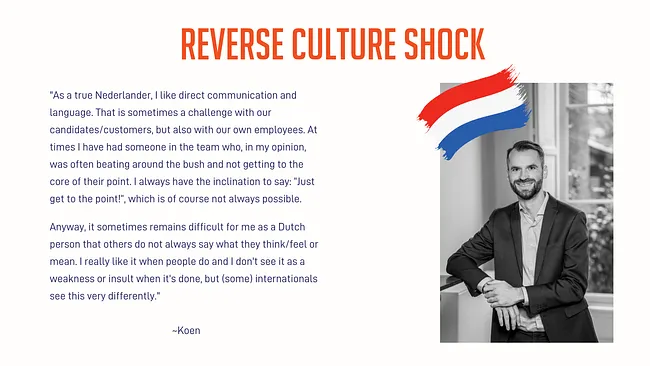
Dutch directness: Rude or refreshingly honest?
Another well-known characteristic of Dutch work culture is direct communication. Dutch colleagues often prefer getting straight to the point, with less small talk or sugarcoating than some of us internationals might be used to.
For those of us unfamiliar with this communication style, it can sometimes come across as blunt or even unfriendly. However, directness is generally intended to create clarity, avoid misunderstandings, and keep communication efficient.
The same applies to feedback. In many Dutch workplaces, giving and receiving feedback is a normal part of professional development. If a colleague points out something you could improve, it doesn't necessarily mean they are unhappy with your performance. They may simply see it as an opportunity to help you grow.
Of course, that does not mean every Dutch colleague communicates in exactly the same way or that no Dutch person is ever rude. Different organizations, teams, and individuals have their own styles, so observing your colleagues and adapting your communication accordingly is always a good starting point.
Our tip: Remember, communication works both ways! Your Dutch teammates will appreciate when you ask questions, express your concerns, and provide feedback yourself. And if a direct comment does hit you wrong, rather than it immediately as criticism, try to consider the intention behind it. If you are unsure about something or it is still bothering, be direct back and ask for clarification. This is usually much more productive than making assumptions.
What is the Dutch work-life balance really like?
The Netherlands has a reputation for valuing work-life balance, and for many international professionals, this is one of the most appealing aspects of working here.
A typical office workday might run from approximately 9 AM to 5 PM, and in many organizations, leaving when your agreed working hours are finished is completely normal. Unlike in some countries, staying late simply to demonstrate commitment or waiting until your manager leaves is not necessarily expected. In fact, your manager will often encourage you to leave on time, take vacation, and participate in the Vrijmibos.
However, a healthy work-life balance should not be confused with a lack of ambition or professional responsibility.
Dutch employers generally value efficiency and productivity during working hours. You are expected to manage your responsibilities, communicate clearly, and deliver the results you have agreed upon. The emphasis is often on what you accomplish rather than how long you remain at your desk.
The social side of work can also be an adjustment. Dutch colleagues may be friendly, approachable, but that does not automatically mean everyone wants to build close personal friendships with their coworkers.
Professional and private lives can remain relatively separate, and people may have different preferences when it comes to sharing personal information or spending time together outside work.
So, if hanging out with your team outside of work is not your style, don’t feel any pressure that your colleagues have to become your best friends. But if it happens, as it often does at Undutchables, that is ‘mooi meegenomen’ (a nice side effect).
Our tip: Basically, there is no single correct way to approach these relationships. Take your time, get to know your colleagues, and find a balance that feels comfortable for you. And perhaps most importantly, remember that there is no single Dutch workplace culture. An international company in Amsterdam might have a very different atmosphere from a smaller Dutch organization in Eindhoven. Company culture, management styles, and the backgrounds of your colleagues all influence what your everyday working environment will look like. So, give yourself time to adjust and figure out what the expectations and vibe in your team and company will be and how your personal style can fit into that.
Do you really need to speak Dutch to find a job?
One of the biggest attractions of the Netherlands for international job seekers is how widely English is spoken. It is entirely possible to live and work in certain international environments without being fluent in Dutch.
But does that mean learning Dutch isn't necessary?
Not quite.
Although English-speaking opportunities certainly exist, competition for these positions can be particularly high. And as the labor market evolves, we are increasingly seeing employers include Dutch language skills in their requirements, even for roles within internationally oriented companies.
Although it might not be necessary for every position, speaking Dutch can be valuable for growing your career, beyond just giving you the ability to communicate with Dutch customers. It can make internal collaboration easier, help you participate in informal conversations, and give you access to a wider range of career opportunities as well.
For example, you might work in an international finance department where English is the main working language, but understanding Dutch financial practices, regulations, and terminology could still be an important advantage that can help you excel in your role and grow in your career.
At Undutchables, we continue to see particular demand for multilingual professionals with German and French language skills, alongside opportunities for speakers of other languages. However, having a combination of language skills, including some Dutch, can help distinguish your profile from other applicants.
Our tip: Start learning Dutch as early as possible! You do not necessarily need to be fluent before beginning your job search, but demonstrating that you are actively developing your language skills can show motivation and help broaden your options.
And don't underestimate the value of the Dutch you have already learned. Even if you are still just starting out with Duolingo, or are currently at an intermediate level, make sure this is clearly reflected in your CV and LinkedIn profile so that potential employers will be able to see your effort and motivation.
Recruitment in the Netherlands: What candidates often misunderstand
Understanding how recruitment works in the Netherlands can also help you approach your job search more effectively.
For example, some international candidates assume recruitment agencies only offer temporary jobs, or that registering with an agency means they will automatically be matched with a vacancy.
In reality, recruitment agencies can work quite differently depending on their specializations, clients, and the types of positions they recruit for.
Temporary contract does not necessarily mean short-term role
In some countries, temporary employment is viewed as less secure or less attractive than being hired directly by a company.
However, in the Netherlands, temporary contracts and recruitment agencies are a common part of the employment market.
Agencies may recruit for temporary assignments, long-term opportunities, or positions where candidates initially work through an agency before potentially transitioning to a direct contract with the employer.
Of course, not every temporary role is intended to become permanent. Some positions are specifically created to cover maternity leave, complete a project, or provide short-term support, but many of the vacancies at Undutchables are for roles within companies that are looking for a long term collaboration, even if the contract starts as a temporary one.
The important thing is to understand the type of contract you are being offered and what opportunities it may provide, rather than assuming that temporary employment automatically means limited career prospects.
Our tip: Ask the recruiter! It makes sense that you want to know what you are getting into and what the future prospects are for a role. Sometimes the expectations are listed clearly in the vacancy, for maternity leave cover for example, but if you are unsure you can always reach out to the recruiter to find out what the company expectations are and what type of contract you would be receiving.
How recruitment agencies can support your job search
Recruitment agencies can offer more than access to vacancies. Depending on the agency and the position, recruiters can help you understand what employers are looking for, prepare for interviews, and communicate your strengths more effectively.
At Undutchables, for example, the recruitment process generally involves registering your profile, applying for suitable vacancies, discussing your background and expectations with a recruitment consultant, and potentially being introduced to an employer.

Having a recruiter introduce you can be especially valuable when your professional background is not immediately obvious from your CV, or when you are trying to switch careers or figure out how to use your skills in a new market. Your consultant can provide additional context about your experience, motivation, and transferable skills to potential employers to help your application stand out.
Our tip: Work with agency recruiters and be open with them! It can feel a bit weird to share so much information with a recruiter, but remember that a recruitment consultant at a recruitment agency (like Undutchables) is trying to match you with companies they work with and vacancies they are responsible for. The more accurate the information is that you share with them, the better chance of finding a good fit.
Your CV needs to tell the right story
One of the biggest mistakes candidates make is assuming their experience will speak for itself.
You might know that your background makes you a strong candidate for a role, but if your CV does not clearly communicate that, a recruiter may never discover the connection.
This is particularly relevant for internationals who have changed careers or worked across multiple industries. Plus, hiring managers in different countries may be looking for different information on a CV, so it is important to make sure that your CV fits the market you are looking in.
For example, someone transitioning from marketing into recruitment might have valuable experience interviewing candidates, managing teams, or assessing people's skills. However, if their CV focuses exclusively on marketing campaigns, those transferable skills could easily be overlooked. And making those applicable skills stand out looks like clear, concise bullet points and keywords in the Netherlands, while it might need to include more numbers and written out accomplishments if you are applying in Germany.
The solution is to tailor your application to the role and market you are targeting.
Highlight relevant experience, use concrete examples, and make sure your professional profile communicates where you want to go next, not just where you've been. It can also help to stay active and make sure you add new skills and development to your CV, especially if you have a CV gap or want to transition into a new area of expertise.
Our tip: Don't forget your LinkedIn profile! Dutch recruiters regularly use LinkedIn to discover candidates, so keeping your professional experience and career interests up to date and in line with your CV can make you more trustworthy and easier to find.
Making a good impression: Authenticity over formality
Another misconception is that candidates need to be extremely formal to impress Dutch recruiters and hiring managers.
Although professionalism is always important, an intake with an agency recruiter is often a relatively open conversation so they can get to know you and find out what types of companies and positions would best match your skills, ambitions, and current situation.
An interview with an employer tends to be a bit more formal and depends on the company culture. Doing some research beforehand, or getting tips from your recruiter, for the interview can be helpful to know how to dress and what to expect. No matter what the culture, potential employers generally want to understand more than just what you can do. They also want to get an idea of who you are, how you communicate, and what motivates you.
That means you do not need to memorize overly formal responses or try to present yourself as someone you're not. Being authentic, approachable, and honest about your experience can make a stronger impression than trying to deliver the perfect rehearsed answer.
Dutch interviewers do tend to appreciate clear, concise answers though. If you are asked about your experience or motivation, try to apply the Goldilocks principle – not too long, and not too short. Get to the point and answer their question clearly while providing enough detail to demonstrate your abilities and personality.
Preparation is key here. Think about how your previous experience connects to the role, what interests you about the company, and what examples you can share to demonstrate your strengths.
Showing genuine motivation and a proactive attitude can go a long way, especially when you are applying for a position in a country where your previous qualifications or professional experience might be less familiar to recruiters and hiring managers.
Our tip: Prepare well so you can enter interviews with confidence! Not every interview will be “the one,” but feeling calm and confident will definitely help you make the right impression when the time comes. Learn about the company, prepare good questions, know your own CV and have specific experiences and accomplishments in mind to demonstrate your skills. All of these things will help you show what you bring to the table and give you a chance to let your personality shine through, so that both you and the interviewer can discover if the role would be a good match.
Relocating to the Netherlands: Preparation starts before the job offer
For candidates applying from abroad, another common assumption is that relocation planning can wait until after securing a job offer.
Unfortunately, this approach can make the recruitment process more difficult.
The Netherlands has a challenging housing market, and moving here can involve several practical steps, including finding accommodation, checking residence and work permit requirements, registering with the municipality, and arranging your personal administration.
Employers are often aware of these challenges, and when considering candidates who do not yet live in the country, they may want to understand how realistic and organized their relocation plans are.
This does not mean you need to have everything arranged before you receive a job offer. However, showing that you have researched your options and have reasonable expectations can make a meaningful difference.
For example, it is helpful to be able to explain which regions you are considering, what your accommodation options might be, and how much time you would realistically need before starting a new position. If you require visa sponsorship, make sure you understand the basic requirements and whether the employer can support your situation.
The main takeaway is that the more clearly you can communicate your relocation plans, the easier it becomes for an employer to assess whether your move is realistic.
Our tip: Have a plan, or at least the beginning of one. We know it is a bit of a weird chicken-or-the-egg cycle to figure out work and living in a new country when coming from abroad. Even if you are still exploring your options, having a plan and knowledge about the possibilities shows that you are serious about the opportunity and have thought beyond the job offer itself.
Salary expectations: Look beyond the monthly paycheck
Salary is naturally one of the biggest considerations when accepting a new job, particularly when moving to another country.
However, comparing salaries across borders is not always as straightforward as it seems.
One of the most common mistakes is focusing exclusively on the gross monthly salary without considering taxation, employment benefits, and living expenses.
Depending on your personal situation, the amount you see on your paycheck may differ significantly from what you are used to. And the amount that actually ends up in your bank account is also different since taxes and other social benefits costs are handled before the money hits your account.
That is why it is helpful to check the estimated net income when you get a job offer rather than simply looking at gross salary figures. Factors such as taxes, pension contributions, and your individual circumstances can all influence the final amount.
Our tip: Don't forget the cost of living! Housing in particular can be expensive in the Netherlands, so understanding your likely expenses is an important part of deciding whether a salary meets your needs.
Understanding Dutch employment benefits
Dutch employment packages can include several additional benefits that aren't immediately obvious from the advertised salary.
One important example is holiday allowance (vakantiegeld), which is generally 8% of your gross wages. It is often paid separately, although the timing and structure can vary per employer.

Other benefits you might encounter include:
- Additional vacation or ADV/ATV days.
- Employer pension contributions.
- Travel or commuting allowances.
- Work-from-home allowances.
- Performance bonuses or a 13th-month payment.
- Training and professional development budgets.
- Fitness allowances or flexible benefit packages.
Not every employer offers all these benefits, so it is worth reviewing the complete compensation package carefully.
Salary negotiations are also a normal part of the Dutch recruitment process. Depending on the role, employer, and available salary range, there may be room to discuss your compensation or additional benefits.
Our tip: Before accepting or rejecting an offer, look at the complete picture. A salary that initially seems lower than expected might come with valuable additional benefits, while an attractive gross salary might not stretch as far as you hoped once you have accounted for taxes and living expenses.
What about health insurance and sick leave?
Two other important aspects of Dutch employment that can surprise international professionals are health insurance and sick leave.
In the Netherlands, everyone is required to have Dutch basic health insurance. Rather than receiving this as part of an employment package, individuals need to arrange and pay for their own policy. Depending on your income and circumstances, you may also qualify for “zorgtoeslag”, a government contribution to help cover your health insurance costs.
Sick leave works differently from what many internationals are used to as well.
In most cases, you do not need to provide your employer with a doctor's note simply to report that you are sick. Instead, you follow your company's sickness reporting procedure, usually by notifying your manager or designated contact person.
Employers generally cannot ask for details about your medical diagnosis. When an illness affects your ability to work for a longer period, an occupational physician (bedrijfsarts/arboarts) may become involved to assess your work capacity and support reintegration.
These are just some examples of how Dutch employment conditions can differ from those in other countries. Understanding these arrangements before starting a new job can help you feel more confident and avoid unnecessary surprises.
Our tip: Check out independer or other similar sites to compare health insurance easily so that you can end up with a policy that is affordable and covers what you will need.
The biggest misconception? That there is only one way to succeed
Perhaps one of the most important things to understand about the Dutch labor market is that there is not one perfect formula for success.
Although certain characteristics are common in Dutch workplaces, every organization has its own culture, priorities, and expectations. The same applies to recruiters and hiring managers, who may value different qualities depending on the role and team.
That means adapting to the Dutch market does not have to mean changing your personality or leaving your international identity behind.
In fact, your cultural background, language skills, and international experience can be valuable assets, particularly in internationally oriented organizations.
The key is learning how to communicate those strengths in a way that connects with the employer's needs and comes across clearly enough to set you apart from other candidates.
Be curious about the differences you encounter, and offer. Take the initiative to ask questions, and try to be open to understanding unfamiliar behavior rather than immediately interpret it through the expectations of your home country.
And if your job search takes longer than expected, remember that preparation and persistence matter. Even when an application does not lead to an offer, maintaining professional communication and a positive relationship with a recruiter can be worthwhile. A position might not be the right fit today, but another opportunity could arise later.
Ultimately, building a career in a new country is a learning experience. The more you understand about the local market and workplace culture, the better equipped you will be to recognize opportunities and make informed decisions about your next steps.
This is a recap of our candidate webinar, ”Expectations and Misconceptions in the Dutch Job Market: What even our closest neighbors may not expect”. You can review information from this and previous webinars on our YouTube channel. Enjoy!
Undutchables
![]()
![]()

Find out more with our downloadable resources

Looking for a job?
Undutchables offers a variety of vacancies. Check out the latest job offers and apply.
We look forward to your application.
